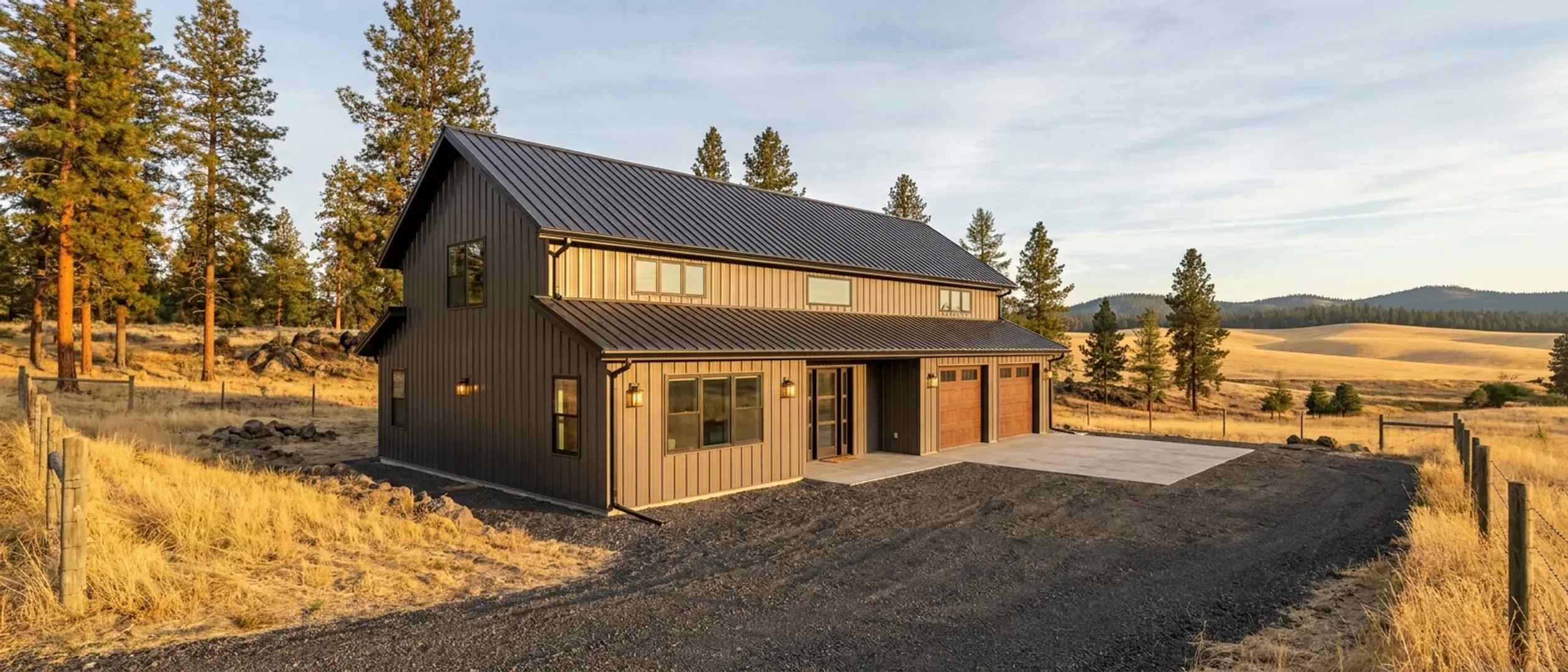
Are Barndominiums Worth It in Washington State?
Whether a barndominium is worth it in Washington depends mostly on three things: the land, the loan and how long you plan to stay. The building itself does what it promises: a clear-span shell, a shop under the same roof and a floor plan that can change. But in this state the land has to clear a water test before any house gets a permit, county zoning sets how much land the house needs, and the appraisal on rural acreage can come in below what the building cost. Insurance in wildfire country, the retail sales tax on building a home on your own land, and a climate that demands serious insulation on both sides of the Cascades all belong in the decision. This page sets out when a barndominium is usually worth it here, when it usually is not, and what to check before deciding.
Figures on this page are cited third-party or government data, not a quote from Washington Barndominium Builders.
Bottom Line Up Front
- A barndominium is usually worth it in Washington when you need the shop anyway, the land already has a clear route to water and allows a house, and you plan to stay long enough that resale comparisons matter less.
- It is usually not worth it when the parcel's water or zoning is uncertain, you may sell within a few years, or the loan depends on an appraisal that few local sales can support.
- Before deciding, get the zoning and the water answer in writing, an insurance quote on the actual design, and a lender that has financed one.
When a barndominium is usually worth it
These are the situations where the strengths of the building line up with what the owner needs.
You need the shop anyway
If the plan already includes a large garage, workshop or equipment building, building it under the same roof as the house is usually simpler than building two structures, and it puts the shop steps from the kitchen.
The land already has water and allows a house
A parcel with a purveyor's letter or an existing well, rural zoning that allows a home, and soil that will take a septic system removes the largest risks before the design starts.
You want an open plan that can change
A clear-span shell has no interior load-bearing walls, so rooms can be moved or added later without structural work.
You are staying a long time
The value of a barndominium to its owner is in using it. The longer you stay, the less a thin resale market matters.
When it usually is not
None of these is a rule, but each one should make you slow down.
The water or zoning is not settled
Without evidence of an adequate water supply there is no building permit. Buying land before that answer is known is the most expensive mistake on this page.
You may sell within a few years
Where few barndominiums have sold, buyers and appraisers have little to compare with. A short hold leaves less time for that to matter less.
The loan depends on a high appraisal
If the financing only works at a full appraisal, a rural appraisal with few comparable sales is a real risk. Talk to a lender first.
The shop is bigger than the house needs
A shop much larger than the living space can add cost without adding appraised value, and Fannie Mae asks lenders to confirm that a property with large outbuildings is residential in nature.
What to check before deciding
Each of these can be answered before you commit money to land or design.
The zoning, in writing
Ask the county or city planning department what the zone allows, the minimum lot size and the setbacks. The legal guide sets out what to ask.
The water and septic answer
Ask the building department what water evidence the parcel needs and whether a Streamflow Restoration fee and limit apply, and ask the local health jurisdiction what its septic site evaluation requires.
An insurance quote on the actual design
In wildfire-prone areas, the insurer's risk score and deductible can change the running cost. Get the quote before the design is final.
A lender that has financed one
Ask how the lender handles appraisals for barndominiums and large shops. The financing guide covers the loan types.
The site's design values and the tax picture
Get the snow, wind, seismic and frost figures from the building department, check whether the land is in current use, and include sales tax on the full contract in the budget.
Reading this because you are weighing a build? The next step is a plan drawn for your program.
What's different in Washington State
The land decides first
RCW 19.27.097 requires evidence of an adequate water supply before a building permit is issued for a home: a purveyor's letter, a water right, or in many areas a water well report. In the watersheds listed in the Streamflow Restoration Act, RCW 90.94, a new home on a new household well pays a $500 fee and accepts a lower annual-average withdrawal limit recorded on the title. County zoning, set under the Growth Management Act, fixes the minimum lot size. A parcel that clears these is a good start. One that does not can make any house, barndominium or not, unbuildable.
Sales tax applies to the whole build
RCW 82.04.050 treats building a structure for a consumer as a retail sale, and the Department of Revenue says prime contractors must collect retail sales tax from the landowner on the gross contract price, without deducting costs. When a contractor builds a barndominium on land you own, budget for sales tax on the full contract, at the rate for the job site.
Current-use land can carry back taxes
Rural acreage is often enrolled in a current-use program as open space, farm and agricultural, or timber land. RCW 84.34.080 says that when classified land is applied to some other use, additional tax is imposed with a penalty of 20 percent. Ask the county assessor how a homesite would affect the classification before you buy or build.
Wildfire is priced by the insurer
Washington's Office of the Insurance Commissioner says most standard home policies cover wildfire as part of fire coverage, but some higher-risk areas now see separate, higher wildfire deductibles, and insurers score homes on factors such as building materials, nearby vegetation, location and defensible space. In high-risk areas, the Commissioner says, homeowners may see more nonrenewals and cancellations. Metal roofing and siding do not burn, which helps, but the quote on the actual design and site is what counts.
Appraisal on acreage
Fannie Mae's Selling Guide accepts unique or nontraditional housing when the appraiser has enough information for a reliable opinion of value, and notes that rural properties often lack recent comparable sales nearby. It also asks lenders to confirm that a property with large outbuildings is residential in nature. Where few barndominiums have sold, the appraisal can come in below cost, which means a larger down payment.
The energy code sets the insulation
Washington's residential energy code, chapter 51-11R WAC, requires every new home to earn additional energy efficiency credits, 5.0, 8.0 or 9.0 depending on size, on top of insulation minimums such as R-60 ceilings. The heating system chosen counts toward those credits. The result is a well-insulated house, but meeting it in a steel or pole barn shell is a real part of the budget, and it is not optional.
Earthquakes and climate shape the engineering
The Department of Natural Resources says Washington has one of the highest risks of large and damaging earthquakes of any state, and the Western Regional Climate Center describes a wet west side and a colder, snowier east side. Snow, wind, seismic and frost values are set by each local jurisdiction, and a barndominium's frame has to be engineered for the figures at its site. That is standard for a pre-engineered kit, but it has to be specified, and higher values can mean a heavier frame.
Pros and cons, honestly
Pros
- A shop and a house built together under one roof.
- A clear-span interior that can be changed later.
- Metal roofing and siding that do not burn, which insurers' wildfire scoring considers.
- A pre-engineered frame that can be specified for the site's snow and seismic values.
- Washington's energy code produces a well-insulated house.
Cons
- The water, zoning and septic answers can make a parcel unbuildable.
- Rural appraisals can come in below cost where comparable sales are few.
- Retail sales tax applies to the full contract price of building on your own land.
- Wildfire-prone sites can face higher deductibles or harder-to-find coverage.
- Energy code insulation and credits are a significant cost in a metal or pole barn shell.
Are barndominiums worth it in Washington?
Do barndominiums hold their value in Washington?
Is it cheaper to build a barndominium than a house in Washington?
Do I pay sales tax on building a barndominium in Washington?
Can I build a barndominium on land I can't get water to?
Will wildfire risk make a barndominium hard to insure?
Can I get a mortgage on a barndominium?
What should I do before deciding?
Questions answered? Tell us what you want to build and we will put real numbers against it.
Sources
- Revised Code of Washington — RCW 19.27.097 (evidence of adequate water supply)
- Revised Code of Washington — Chapter 90.94 RCW (streamflow restoration)
- Revised Code of Washington — RCW 36.70A.070 (comprehensive plans, rural element)
- Revised Code of Washington — RCW 82.04.050 (retail sale includes construction for consumers)
- Washington Department of Revenue — Custom construction
- Revised Code of Washington — RCW 84.34.080 (current use: change in use)
- Washington Office of the Insurance Commissioner — Wildfires and insurance
- Fannie Mae Selling Guide — B4-1.3-08, Comparable Sales
- Fannie Mae Selling Guide — B4-1.3-05, Improvements Section of the Appraisal Report
- Washington Administrative Code — WAC 51-11R-40620 (additional energy efficiency credits)
- Washington Administrative Code — WAC 51-11R-40213 (insulation and fenestration requirements, Table R402.1.3)
- Washington Administrative Code — WAC 51-51-0301 (design criteria, Table R301.2)
- Washington Department of Natural Resources (Washington Geological Survey) — Earthquakes and Faults
- Western Regional Climate Center — Climate of Washington (state narrative)
Keep reading
The pages that answer the next question this one raises.
Are barndominiums legal in Washington?
Water, zoning, septic, the code and permits.
Read itBarndominium pros and cons in Washington
Rain, condensation, earthquakes, snow and appraisal in detail.
Read itBarndominium vs house cost
How the costs compare, with sourced figures.
Read itBarndominium financing
Construction loans, appraisals and what lenders ask for.
Read itBarndominium kits
Kit packages and what they include.
Read itStart the survey
Tell us about your land and what you want to build.
Read itWant a real number instead of a range?
Start the survey and tell us about your land and what you want to build. Include the county and the parcel number if you have them, because in Washington the county zoning, the septic permit from the local health jurisdiction and the water answer change the budget more than the building does. The survey costs nothing.