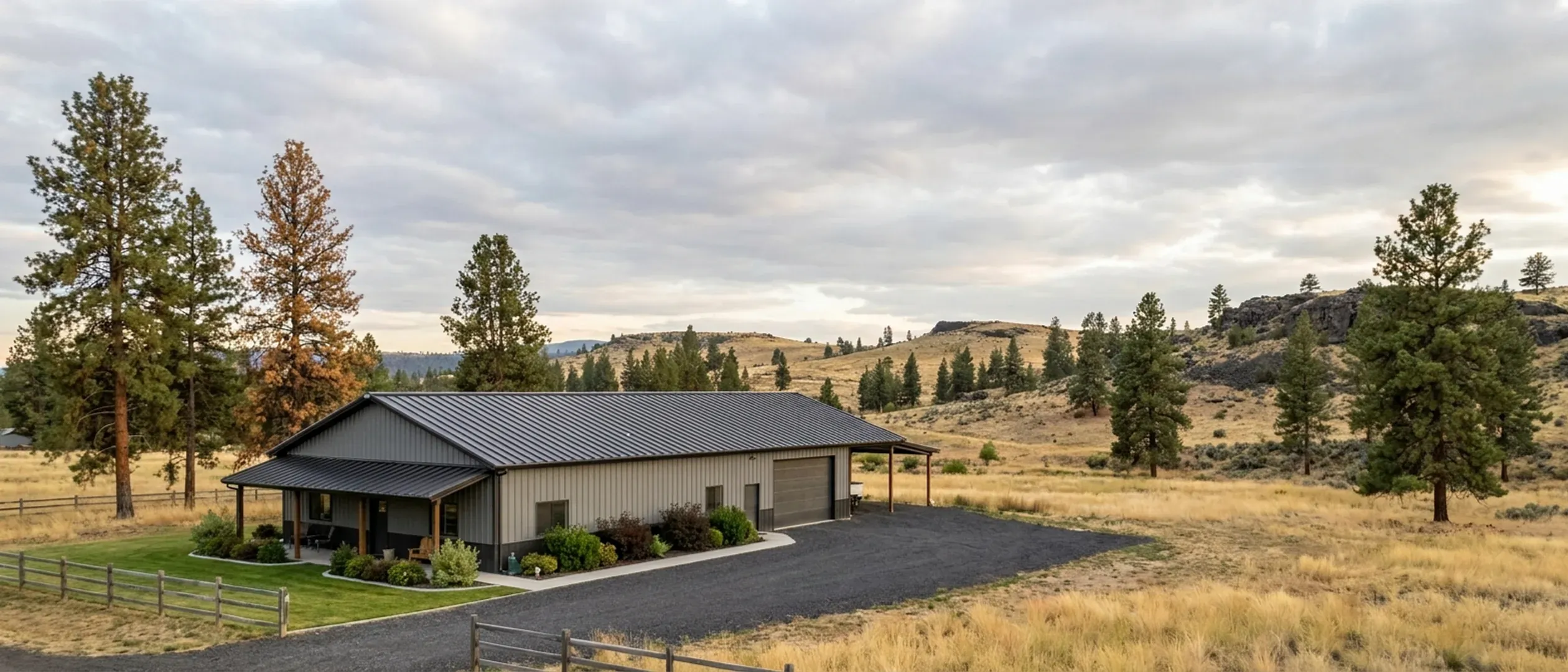
Barndominium vs House Cost in Washington State: Where the Money Actually Differs
A barndominium is sold on the idea that it costs less than a house. Part of that is true and most of it is not, and the published numbers show exactly where the line falls. A steel or pole barn frame changes the framing and the exterior shell, which NAHB's builder survey puts at under a third of construction cost. The rest, from the foundation to the kitchen cabinets, the wiring and the heat pump, costs what it costs in any house, and Washington's energy code asks the same of both. This guide compares the two with Census and NAHB figures, then adds the Washington difference most comparisons miss: when a contractor builds on land you own, sales tax applies to the whole contract, which is not how a new house bought from a builder is taxed. None of the figures is our pricing.
Figures below are industry data from cited third-party sources, not a quote from Washington Barndominium Builders. Every project is priced individually.
Bottom Line Up Front
- The frame is the smaller part of the bill. In NAHB's 2024 builder survey, framing is 16.6% of construction cost and exterior finishes 13.4%; interior finishes (24.1%) and the plumbing, electrical and HVAC rough-ins (19.2%) are larger, and a barndominium changes none of them.
- In the Census Bureau's 2025 figures for the West, a house built by a contractor on the owner's land cost $176.87 to $213.85 per square foot (median to average), and a new house bought from a builder sold for $211.98 to $222.47, both with the land excluded. The buyer's figure includes the builder's overhead and profit.
- In Washington, a custom build on your own land carries retail sales tax on the full contract price; the sale of a finished spec house is taxed as a real estate sale. Compare the two on the same basis.
Published cost figures
Third-party and government figures, each with its source. None of them is a quote, and none of them is ours.
| Measure | Range | Source |
|---|---|---|
| Custom: houses built by a contractor on the owner's land, West region, started in 2025 (median to average, land excluded) | $177–$214per sq ft | U.S. Census Bureau, Characteristics of New Housing 2025, Median and Average Contract Price per Square Foot of New Contractor-Built Single-Family Houses Started: West median $176.87, average $213.85 (read 27 Sep 2026) — https://www.census.gov/construction/chars/xls/contractpricesqft_cust.xls |
| Bought new: detached houses sold by builders, West region, 2025 (median to average, lot excluded) | $212–$222per sq ft | U.S. Census Bureau, Characteristics of New Housing 2025, Median and Average Price per Square Foot of Floor Area in Detached New Single-Family Houses Sold: West median $211.98, average $222.47 (read 27 Sep 2026) — https://www.census.gov/construction/chars/xls/soldpricesqft_cust.xls |
| Construction cost alone, national builder survey, 2024 (no lot, overhead, marketing or profit) | $162per sq ft | NAHB, Cost of Constructing a Home 2024 (January 2025): average construction cost $428,215, about $162 per square foot; national averages only (read 27 Sep 2026) — https://www.nahb.org/-/media/NAHB/news-and-economics/docs/housing-economics-plus/special-studies/2025/special-study-cost-of-constructing-a-home-2024-january-2025.pdf |
What actually moves the number
Framing: the line a barndominium changes
NAHB's 2024 survey splits framing into framing including the roof structure (11.6% of construction cost), trusses (3.0%) and sheathing (1.5%). A clear-span steel frame or a pole barn frame replaces much of that with fewer, larger members. Whether it costs less depends on the span, the design loads your building department sets, and the price of steel when you order.
The exterior shell
Exterior wall finish (5.7%), roofing (3.9%) and windows and doors (3.7%) make up most of NAHB's exterior-finish share. Metal wall and roof panels on a barndominium replace siding and shingles; windows and doors cost the same in either building.
The shop under the same roof
The clearest saving is structural: one building with a shop bay instead of a house plus a separate shop or garage. One foundation, one roof and one set of exterior walls do the work of two, and the shop needs no kitchen, bathrooms or interior finishes.
The appraisal
Fannie Mae's appraisal rules accept unique and nontraditional housing if the appraiser has enough information to value it, but a rural barndominium can lack close comparable sales, and a large barn or shop can make a lender ask whether the property is residential or agricultural. A lower appraisal means more cash at closing, whatever the build cost.
What the Census Numbers Compare
Two Census series look alike and measure different things.
Built for you on your land
The Census contract price covers houses a contractor builds for an owner on land the owner already holds. In the Census West figures for 2025 that was $176.87 per square foot at the median and $213.85 on average, with the land excluded. This is the closest published match to a barndominium, which is almost always built that way.
Bought new from a builder
The Census sales price covers new detached houses a builder sold, with the lot value excluded. In the Census West figures for 2025 that was $211.98 per square foot at the median and $222.47 on average. NAHB's survey shows what sits in a builder's price besides construction: overhead and general expenses (5.7% of the sales price), marketing (0.8%), sales commission (2.8%) and profit (11.0%).
Neither is a barndominium figure
The Census classifies houses by framing material. In the West in 2025, 99% of contractor-built houses were wood-framed and about 1% steel-framed, so neither series isolates barndominiums. A pole barn home is wood-framed and counts with every other wood house.
Compare like with like
Put a turnkey barndominium quote beside the Census contract figure, not beside a kit price or a resale listing. A kit covers only the shell, and an existing house's price carries the land, the age of the house and the neighborhood.
Where a Steel or Pole Barn Shell Changes the Budget
The savings, where they exist, sit in the structure and the skin.
Fewer, larger framing members
A clear-span steel frame or a pole barn (post-frame) building carries the roof on columns and trusses spaced well apart, instead of on stud walls throughout. That changes NAHB's framing line (16.6% of construction cost), and it leaves the interior free of bearing walls, so the floor plan can change without moving the structure. See steel construction and pole barn homes.
Metal panels instead of siding and shingles
Exterior wall finish and roofing together are 9.6% of NAHB's construction cost. Metal panels replace both on most barndominiums, so compare the panel package against siding plus roofing, not against the whole exterior line.
The foundation may change, not disappear
A pole barn frame can stand on embedded posts or piers, and a steel building usually sits on a slab with anchored footings. The living area still needs the foundation, insulation and frost protection the residential code requires, so this line (10.5% in NAHB's survey) moves less than people expect.
One building instead of two
If you would otherwise build a house and a separate shop, the barndominium's advantage is sharing the foundation, roof and walls. If you would not build the shop at all, that saving does not exist; you are buying more building, not a cheaper house. See barndominium with shop plans.
Where the Costs Are the Same
Most of a house is inside the walls, and none of it knows what the frame is made of.
Interior finishes
NAHB's interior-finish share is 24.1% of construction cost: cabinets and countertops 4.5%, flooring 3.6%, drywall 3.3%, trim and doors 3.0%, painting 2.6%, insulation 1.6%. A barndominium's kitchen and bathrooms cost what they cost in any house.
Plumbing, electrical and HVAC
The rough-ins are 19.2% of NAHB's construction cost, split almost evenly between plumbing (6.3%), electrical (6.4%) and HVAC (6.3%). Licensed trade contractors handle this work in either building, and Washington's energy code weights the heating choice the same way in both.
Site work and utilities
NAHB puts site work at 7.6% of construction cost on a typical lot. On raw rural land the well or water connection, the septic system, the power run and the driveway are the same bill for a barndominium as for a stick-built house.
Permits and plan review
A barndominium with living space is a house under Washington's building code and is permitted like one. See are barndominiums legal in Washington State and permitting.
Reading this because you are weighing a build? The next step is a plan drawn for your program.
What's different in Washington State
Sales tax: building on your land vs buying from a builder
Washington treats construction for a consumer as a retail sale. The Department of Revenue's construction guide says a prime contractor must collect retail sales tax from the landowner on the gross contract price. A speculative builder building on its own land sells a finished house as real estate, taxed as a real estate sale, and pays sales tax itself on its materials and on its subcontractors' charges. So a custom barndominium and a new spec house are not taxed the same way; put the tax into the custom number before you compare.
The energy code treats them the same
Every new Washington home, barndominium or not, must meet the 2021 Washington State Energy Code – Residential and earn additional efficiency credits: 5 for a small home, 8 for most, 9 above 5,000 square feet. A steel or pole barn shell has to reach the same envelope and heating standard as a wood-framed house, so there is no energy-code discount for the building type.
Water and septic cost the same for either
A Washington building permit for any house needs evidence of an adequate water supply, and off the sewer a septic permit from the local health jurisdiction. On rural land those costs attach to the parcel, not to the style of building, so they belong on both sides of the comparison.
Land decides more than the building type
The 2022 Census of Agriculture puts farmland with its buildings at $50,663 an acre in Kitsap County and $2,782 in Yakima County. In Washington, where you build can move the total far more than whether the frame is steel, poles or studs. See the cost guide for the county figures.
Pros and cons, honestly
Pros
- One structure can carry a house and a shop under a single roof and foundation.
- A clear-span frame leaves the interior free of bearing walls, so the layout can change later.
- Metal wall and roof panels replace siding and shingles.
- A shell kit lets an owner enclose the building first and finish the interior in stages.
Cons
- Interior finishes and mechanical systems, the largest shares of construction cost, cost the same as in any house.
- Washington's energy code asks the same of a steel or pole barn shell as of a wood-framed house.
- A custom build on your land carries Washington retail sales tax on the full contract price.
- Appraisals can come in low where there are few comparable barndominium sales.
Is a barndominium cheaper than a house in Washington State?
Is it cheaper to build a barndominium or buy a house?
Do I pay sales tax on a custom barndominium in Washington?
Is a pole barn home cheaper than a steel barndominium?
Does a barndominium appraise like a house?
Where does a barndominium actually save money?
Does Washington's energy code cost more for a metal building?
Questions answered? Tell us what you want to build and we will put real numbers against it.
Sources
- U.S. Census Bureau — Median and Average Contract Price per Square Foot of New Contractor-Built Single-Family Houses Started (Characteristics of New Housing, 2025)
- U.S. Census Bureau — Median and Average Price per Square Foot of Floor Area in Detached New Single-Family Houses Sold (Characteristics of New Housing, 2025)
- U.S. Census Bureau — Type of Framing in New Single-Family Houses Completed (Characteristics of New Housing, 2025)
- NAHB — Cost of Constructing a Home 2024 (January 2025)
- USDA National Agricultural Statistics Service — 2022 Census of Agriculture, Washington county data, Table 8
- Washington Department of Revenue — Construction industry guide: custom construction
- Washington Department of Revenue — Construction industry guide: speculative building
- WAC 458-20-170 — constructing and repairing buildings: prime contractors and speculative builders
- WAC 51-11R-40620 — Washington State Energy Code, Residential: additional energy efficiency credits (R406.3)
- RCW 19.27.097 — building permit applications: evidence of an adequate water supply
- WAC 246-272A-0200 — on-site sewage systems: permit from the local health officer
- Fannie Mae Selling Guide — B4-1.3-05, Improvements Section of the Appraisal Report
- Fannie Mae Selling Guide — B4-1.3-08, Comparable Sales
Keep reading
The pages that answer the next question this one raises.
How much does it cost to build a barndominium in Washington State?
The published cost-per-square-foot benchmarks, land values by county, and Washington's own cost lines.
Read itWhat size barndominium can you build for your budget?
Turn a budget into square feet, including small barndominiums.
Read itSteel construction
Clear-span steel frames and what they change about the building.
Read itPole barn homes
Post-frame construction as a home, and where it differs from a steel shell.
Read itBarndominium with shop
The plan type where a barndominium's one-building advantage is clearest.
Read itWant a real number instead of a range?
Start the survey and tell us about your land and what you want to build. Include the county and the parcel number if you have them, because in Washington the county zoning, the septic permit from the local health jurisdiction and the water answer change the budget more than the building does. The survey costs nothing.